Hardware
Boards I designed from a blank schematic. Scroll, and the first one shows you around.
- O0X
- Camera + sensor node, 6 layers, 90 × 70 mm
- MOTE
- Tiny Linux computer, 61 × 45 mm
- MOTE H1
- RK3576 computer board, in design
- Tools
- KiCad, layout generated by script
O0X
Two boards, one node
The brain of the next Ornimetrics feeder: a main board and a sensor card that stands beside it. This is the real KiCad model.
Brain
A vision chip
A Rockchip RV1106G3 with its memory inside the package, and a RISC-V co-processor that stays awake while it sleeps.
- RV1106G3256 MB in package
- CH32V203always on
Eyes
Two cameras
- Camera AMIPI CSI
- Camera BMIPI CSI
- microSDboot + storage
Hands
Power and servos
- USB-Cpower + link
- Terminalpower in
- Servostwo outputs
Senses
The sensor card
Standing up, away from the processor's heat.
- Climatetemp, humidity, pressure
- Lightambient + UV
- HeatIR thermometer
- Distance8 × 8 zones
- Soundtwo microphones
Built
Off to the fab
Six copper layers, zero design-rule errors, fabricated in August 2026 and assembled by hand.
The hard part
Why six layers
Nothing fits between the processor's pads, so all 128 pins escape outward on the top layer. Four layers ran out of room; six didn't.
Earlier
MOTE
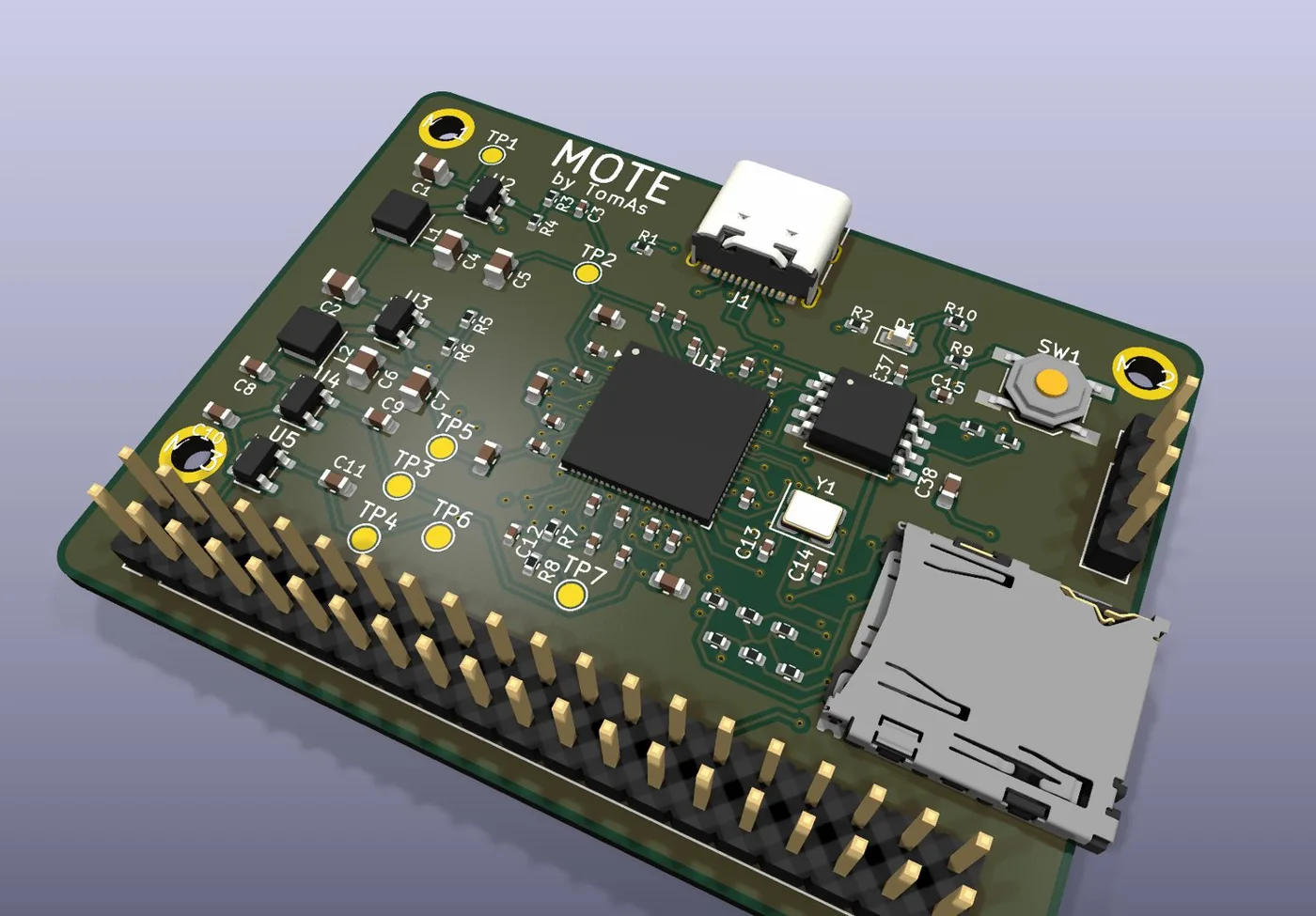
MOTE, from its KiCad layout. Grab it and turn it over.
A Linux computer the size of a business card: an Allwinner F1C200s with 64 MB of memory inside the chip, microSD boot, USB-C and an expansion header, fully routed over a solid ground plane.
Next
MOTE H1
My own single-board computer: a Rockchip RK3576, 4 GB of LPDDR4X, Wi-Fi, USB 3, two cameras and PCIe, on six layers with its memory routed on the board.
- RK3576
- 8-core processor with an NPU
- 4 GB
- LPDDR4X, routed on the board
- $600
- budget for three boards, parts included